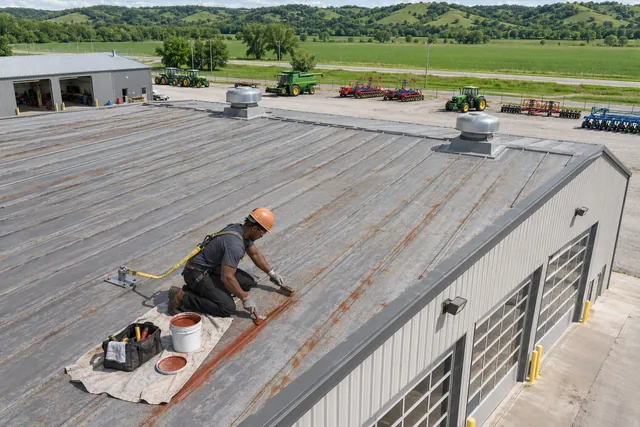
Commercial Metal Roof Coating
Steel roofs with rusty laps need rust primer and new screws first, then silicone or acrylic on top.
Council Bluffs commercial metal roof coating
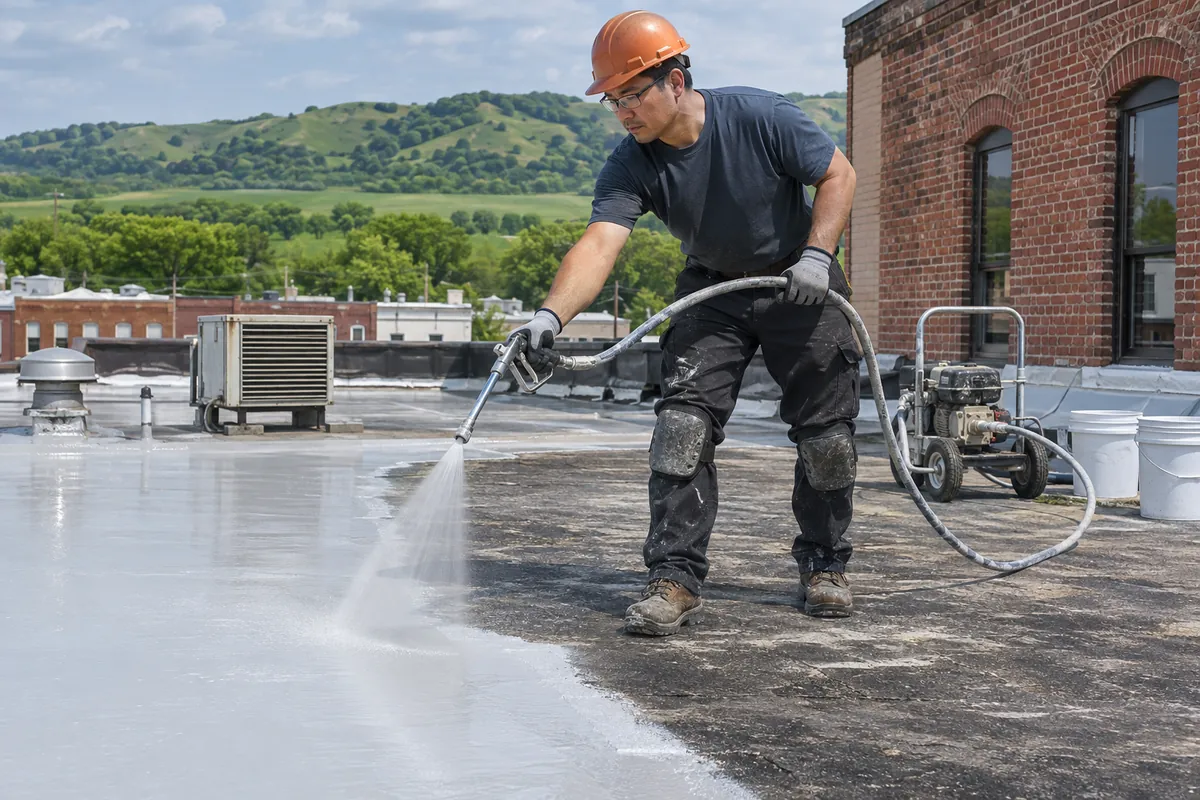
As a Council Bluffs silicone roof coating contractor, we check for wet insulation under the ponds, prime the surface, and spray silicone where water sits.
Council Bluffs silicone roof coating fits roofs where water sits for a day or two. Wet insulation under those spots changes the plan, so we check it first.
Ponding roofs leak in predictable places. Here is what shows up inside and where it starts above.
Columns sit under the low points of a roof, so drips beside a column usually mean water is pooling directly above it.
Dirt rings mark where water sat for days, and the membrane or old coating under them wears out first.
Ceiling tiles going brown in a circle around a roof drain line point to a failed drain clamp or a clogged strainer.
A drain bowl set above the roof surface leaves a moat of water around it that finds every crack.
Frost or ice on the ceiling of a cooler can mean water got into the insulation and froze there.
Silicone over wet insulation traps the water, so we pull cores and replace soaked boards before coating.
Silicone comes in a few forms. Which one goes on depends on the roof surface and how much water it sees.
| Option | Best For | What Goes On | Notes |
|---|---|---|---|
| High-solids silicone | Most low-slope steel and membrane roofs | Primer as needed, one heavy pass | Fewest trips across the roof |
| Two-coat silicone | Rough, older panels or heavy ponding | Base coat, then a second full coat | Covers texture evenly |
| Silicone over seam fabric | Laps and curbs that move | Fabric embedded in base, then topcoat | Joints get extra thickness |
Silicone earns its keep on roofs that never fully drain. Here is what changes for each person tied to the building.
Ponds that last more than two days are the first place we check for wet insulation. Book an inspection before the next freeze.
We map every pond, check drains and curbs, and pull cores under the low spots to find any wet insulation.
Soaked boards under the ponds get cut out and replaced so no water ends up sealed under the coating.
The roof gets washed, and a small adhesion test on the old surface shows whether a primer is needed.
Laps, curbs, and drain flashings get a base coat with fabric so the moving joints carry extra thickness.
High-solids silicone goes on in one heavy pass or two coats, measured with a wet-mil gauge as it goes.
Most of the work happens before the silicone comes out.
Silicone is one of five systems. These three cover the roofs it does not.
Steel roofs with rusty laps need rust primer and new screws first, then silicone or acrylic on top.
Council Bluffs commercial metal roof coating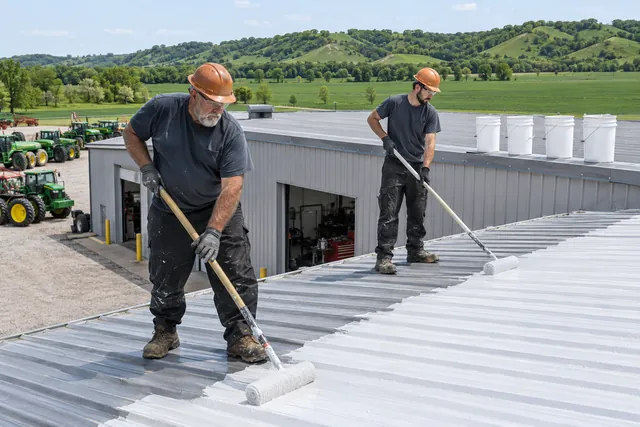
Sloped panels that never hold water can take acrylic, which costs less per gallon and recoats easily.
Council Bluffs acrylic roof coating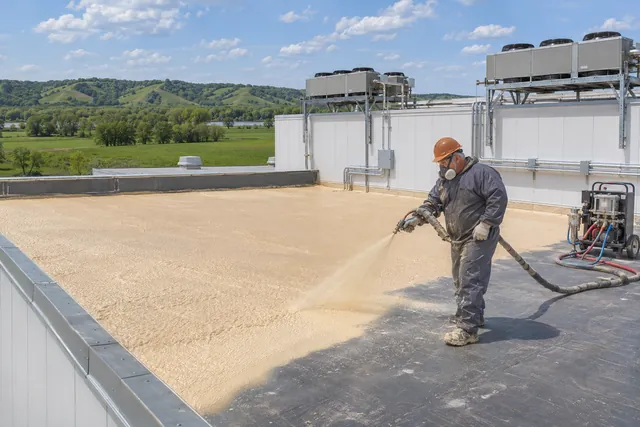
Flat roofs that need insulation or extra slope to drain can get foam first and a silicone coat over it.
Council Bluffs spray foam roofingCoats, cost, downsides, and permits for silicone here.
One or two, set by the dry film thickness the system calls for. Laps and screws always get a reinforced base layer first. On smooth panels, a single heavy pass of high-solids silicone usually reaches the target. Rough or older steel often takes a second coat so the texture is covered evenly.
Call UsSilicone life follows the mils applied and the upkeep afterward. Coating makers rate their silicone systems by thickness, often 10 to 20 years. Dirt build-up, punctures from foot traffic, and storm damage left unrepaired cut that short, and a fresh silicone coat renews it.
Silicone matches buildings with gutters or low sections that hold water after storms. Acrylic matches buildings that drain well and see steady sun. Silicone handles ponding but gathers dirt and only takes more silicone later, while acrylic costs less per gallon and recoats easily but breaks down under standing water.
Silicone jobs plan inside the coating range of about $2.50 to $4 per square foot. Square footage, the number of laps and screws, rust treatment, the thickness the system needs, and lift access move the number. Wet insulation found in cores adds a replacement cost before coating.
Three come up most. Silicone holds dirt, which dulls its reflectivity over time. It gets slick when wet, so roof paths need care. And later recoats must also be silicone. We add walkway pads near rooftop units and plan cleaning around those limits.
It depends on the scope, and the Council Bluffs Building Division makes that call. A coating that only resurfaces the roof is treated differently from spray foam, which adds insulation and weight. We confirm the requirement with the city for your address before work begins.
Tell us where the water sits on your roof, and we will check what is under it before quoting silicone.